Quick Facts
- Category: Software Tools
- Published: 2026-05-16 04:31:55
- Engineering Teams Ditch Traditional Structures as AI Agents Take Over Code Creation
- Withings Unveils Medical-Grade Smart Scale with ECG and Nerve Detection: Breaking #HealthTech
- Military AR Headset Prototype Lets Soldiers Control Drones with Eye Movements and Voice Commands
- 5 Steps a California Startup Is Taking to Shield Earth from Rogue Asteroids
- How to Add Meaningful Structure to Your Web Pages with the Block Protocol
Overview
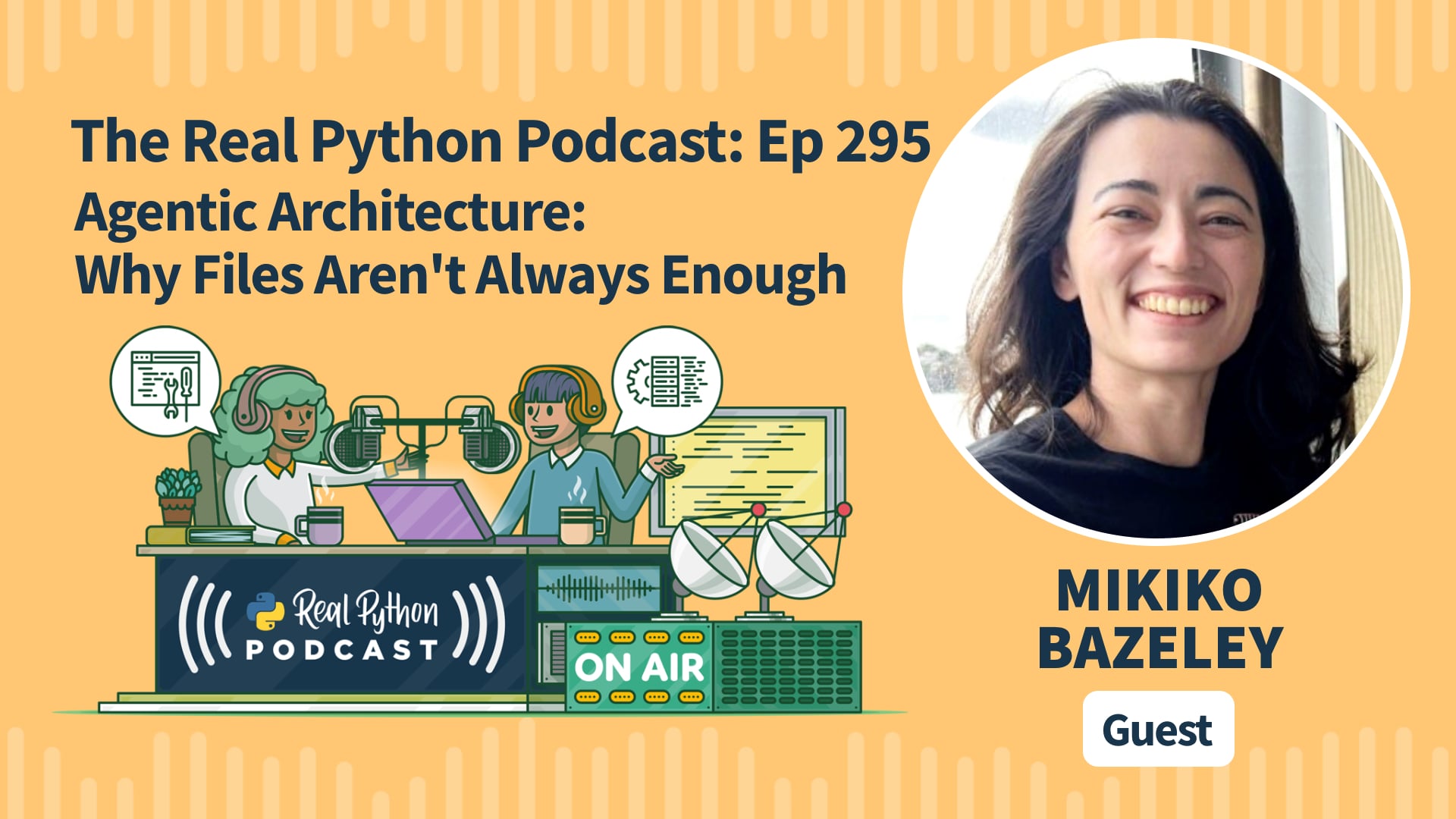
Agentic architectures empower AI systems to act autonomously, often relying on a memory or context store to maintain coherence across interactions. A common approach is to use files—documents, logs, or raw text chunks—as the primary context for the agent. However, this file-based workflow introduces critical bottlenecks: context windows become bloated, retrieval falters, and the agent eventually collapses under its own memory. In this tutorial, we dissect why files aren't always enough, why massive context windows tend to collapse, and how to engineer robust context through context engineering—a discipline that blends chunking, retrieval, and dynamic summarization. Drawing on insights from the Real Python Podcast’s discussion with Mikiko Bazeley (MongoDB), we’ll walk through a practical, code-driven approach to building an agent that avoids these pitfalls.
Prerequisites
- Intermediate Python knowledge (3.8+)
- Familiarity with LLM APIs (e.g., OpenAI, Anthropic) and basic agent loops
- Understanding of embeddings and vector databases (e.g., MongoDB Atlas, Pinecone, Chroma)
- Install
openai,pymongo,langchain(or equivalent) in your environment
Step-by-Step Instructions
1. Dissect the File-Based Agent Workflow
Most naive agents operate like this:
- Load all relevant files into a single context string.
- Feed the entire string to the LLM as system or conversation history.
- Generate a response based on that static context.
Why this fails: Token limits (e.g., 8K, 32K, 128K) are finite. As you add more files, you quickly hit the ceiling. The model’s attention mechanism degrades in the middle of extremely long contexts—a phenomenon known as context collapse or lost in the middle. The agent cannot reliably retrieve specific details buried in thousands of tokens.
2. Embrace Context Engineering
Context engineering replaces monolithic file loading with a dynamic, retrieval-augmented approach. The core idea: select only the most relevant pieces of information for each agent step.
Key techniques:
- Chunking: Break large documents into small, semantically coherent pieces (256–512 tokens each).
- Embedding & Indexing: Convert each chunk into a dense vector using a model like
text-embedding-3-small. Store vectors in a vector database. - Retrieval: At each agent step, query the database for the top-k chunks related to the current user query or agent task.
- Summarization Loop: Optionally compress retrieved chunks or summarize conversation history to stay within a context budget (e.g., 2000 tokens).
Implement a minimal example:
import openai
from pymongo import MongoClient
from langchain.text_splitter import RecursiveCharacterTextSplitter

client = MongoClient("mongodb://localhost:27017")
db = client["agent_context"]
collection = db["chunks"]

# Chunk and embed documents
def index_document(file_path):
    with open(file_path) as f:
        text = f.read()
    splitter = RecursiveCharacterTextSplitter(chunk_size=512, chunk_overlap=50)
    chunks = splitter.split_text(text)
    for chunk in chunks:
        resp = openai.Embedding.create(input=chunk, model="text-embedding-3-small")
        emb = resp['data'][0]['embedding']
        collection.insert_one({"text": chunk, "embedding": emb})
3. Design an Agent with Dynamic Context
Instead of dumping all file content into the prompt, the agent retrieves context on-demand:
def retrieve_context(query, top_k=5):
    query_emb = openai.Embedding.create(input=query, model="text-embedding-3-small")['data'][0]['embedding']
    # Perform vector search using MongoDB Atlas Search or a simple cosine similarity
    results = collection.aggregate([
        {"$vectorSearch": {
            "queryVector": query_emb,
            "path": "embedding",
            "numCandidates": 100,
            "limit": top_k
        }}
    ])
    return [doc["text"] for doc in results]

def agent_step(user_message, conversation_history=[]):
    context_chunks = retrieve_context(user_message)
    context = "\n\n".join(context_chunks)
    system_prompt = f"You are an agent with access to the following context. Answer the user's question based on it.\n\nContext:\n{context}"
    messages = [{"role": "system", "content": system_prompt}] + conversation_history + [{"role": "user", "content": user_message}]
    resp = openai.ChatCompletion.create(model="gpt-4", messages=messages, max_tokens=500)
    return resp.choices[0].message.content
This design scales naturally because the context never exceeds the token budget. The agent only sees relevant chunks, dramatically reducing noise and preventing context collapse.

4. Use MongoDB for Scalable Context Storage
As highlighted in the podcast, MongoDB with Atlas Vector Search is a production-grade solution. Beyond simple storage, it supports:
- Hybrid search (vector + keyword) for better recall
- Change streams to update context in real-time
- Aggregation pipelines to deduplicate or summarize context on the fly
Example schema for a more sophisticated agent memory:
{
  "session_id": "abc123",
  "timestamp": ISODate(...),
  "chunk": "original text",
  "embedding": [...],
  "metadata": {"source": "document.pdf", "page": 5}
}
During agent execution, query by session or topic. Consider using MongoDB's $out stage to periodically compress older context into summary chunks.
5. Test and Validate Against Context Collapse
Simulate a large context scenario:
- Create 100+ chunks from a long document.
- Ask a specific question that requires a piece buried in the middle.
- Compare answers between:
- Naive file-based agent (all 100 chunks concatenated)
- Retrieval agent (top-5 chunks)
- Measure correctness, relevance, and response length.
You should observe that the retrieval agent avoids hallucinations and correctly cites the source, while the naive agent either omits details or fabricates them.
Common Mistakes
- Storing unstructured data without metadata: Without tags like source, date, or relevance, retrieval becomes blind. Always include metadata.
- Not managing the context budget: Even with retrieval, conversation history can grow. Implement a sliding window or summarization step after N turns.
- Using a flat file system for chunk storage: Files lack indexing and real-time query capabilities. Use a vector database.
- Ignoring chunk boundaries: Splitting mid-sentence or across concepts breaks coherence. Use recursive splitters or sentence-aware boundaries.
- Over-reliance on a single embedding model: Different domains may require fine-tuned or multilingual embeddings. Experiment with alternatives.
Summary
File-based agent workflows are brittle because they ignore the fundamental bottleneck of context windows. By adopting context engineering—chunking, embedding, retrieval, and dynamic allocation—you build agents that remain coherent at any scale. MongoDB’s vector search capabilities further streamline this process, turning a scattered file system into a responsive knowledge base. The result: an agent that remembers what matters, discards what doesn’t, and avoids the collapse that plagues monolithic contexts.