Quick Facts
- Category: Cybersecurity
- Published: 2026-05-05 00:55:56
- How to Score a $10 Discount on Splatoon Raiders for Switch 2 Preorder
- Vivo X300 Ultra Emerges as Samsung's Biggest Android Threat — Analysts Call for Urgent Innovation
- The Slow Evolution of Programming: From COM to Stack Overflow
- Tech Pioneers Then and Now: Ask Jeeves and Apple Vision Pro
- 5 Critical Takeaways from BleepingComputer's Instructure Data Breach Retraction
On April 9, 2026, a sophisticated watering hole attack struck the CPUID website, the official source for popular system tools like CPU-Z and HWMonitor. For 19 hours, threat actors compromised the vendor's API to redirect legitimate download requests to malicious servers, bundling a signed binary with hidden malware. SentinelOne's autonomous AI EDR detected and blocked the attack within seconds, preventing widespread compromise. This incident reveals systemic vulnerabilities in software supply chains and offers critical takeaways for defenders. Here are the five most important lessons from this attack.
1. The Attack Vector: Trusted Infrastructure Turned Against Users
Attackers compromised CPUID's domain at the API level, silently redirecting download requests to attacker-controlled servers. Users who visited the official site received a legitimate, properly signed binary—but with a malicious payload bundled inside. This attack exploited the trust chain: users followed all security advice (download from official site, verify signature) yet still got infected. The lesson: never assume vendor infrastructure is safe. Implement runtime behavioral monitoring to catch anomalies even when files appear legitimate.

2. Behavioral Anomalies: The Process Chain That Gave It Away
SentinelOne's agent flagged the attack when cpuz_x64.exe (a genuine, signed binary) spawned PowerShell, which then spawned csc.exe (C# compiler) and cvtres.exe. Normal CPU-Z operation never triggers this chain. The malicious CRYPTBASE.dll—placed in the application directory—hijacked Powershell.exe to load a C# payload using csc.exe. This behavioral detection worked because it focused on what processes do, not just what files look like. Organizations must deploy EDR that analyzes process lineage and flag abnormal executions.
3. Five Behavioral Indicators That Triggered Autonomous Blocking
Within seconds, SentinelOne detected a convergence of five specific behaviors:
- Anomalous API resolution: The process bypassed the OS loader to locate system functions via non-standard methods.
- Reflective code loading: Executable code ran from memory with no corresponding file on disk.
- Suspicious memory allocation: Read-Write-Execute (RWX) permissions were requested—a classic payload staging pattern.
- Process injection patterns: Execution flow indicated code was redirected into a secondary process to mask origin.
- Heuristic shellcode signatures: Sequential operations matched automated exploitation toolkits preparing for command execution.
These indicators allowed the agent to terminate and quarantine the processes autonomously, preventing escalation. No human intervention was needed. This underscores the value of AI-driven endpoint detection that can correlate multiple low-level signals into high-fidelity alerts.
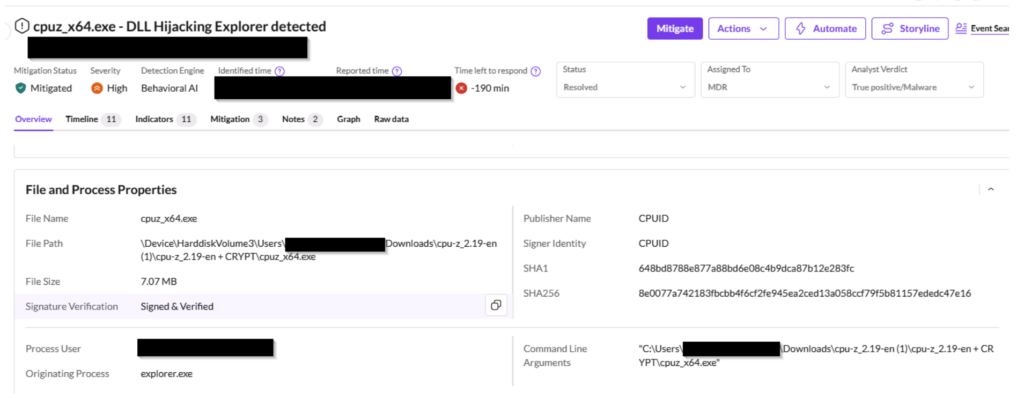
4. Broader Supply Chain Threats: A Systemic Shift
SentinelOne's Annual Threat Report identifies this pattern as a systemic shift: attackers now compromise trusted identities—developers, maintainers, and distribution infrastructure—rather than breaking into systems directly. In late 2025, the GhostAction campaign exploited a compromised GitHub maintainer account to push malicious workflows that stole secrets. Concurrently, a phishing attack against an NPM package maintainer deployed code to intercept cryptocurrency transactions. In both cases, commits appeared legitimate because they came from valid accounts. The CPUID incident extends this trend: the supplier's own download channel became the delivery mechanism. Identity verification alone is insufficient when tools can be weaponized post-authentication.
5. Autonomous Response Is No Longer Optional
The attack ran for 19 hours, but SentinelOne's agent blocked it in the first seconds of execution. Without autonomous EDR, many organizations would have relied on signature-based detection or manual analysis—both too slow for a supply chain attack where the binary is signed and appears legitimate. The agent's ability to terminate and quarantine the malicious processes without human oversight prevented lateral movement or data exfiltration. As software supply chain attacks become more frequent and sophisticated, security tools must be capable of making real-time, independent decisions based on behavioral analysis. Delaying response by even minutes grants adversaries the foothold they need.
The CPU-Z watering hole attack serves as a stark reminder: trust in software supply chains is a liability, not a guarantee. By focusing on behavioral detection, understanding attack patterns, and embracing autonomous response, organizations can defend against even the most sophisticated distribution-channel compromises. The next attack will work the same way—make sure your defenses are ready.